5 fairytale castles you can actually visit

Every castle list starts — and ends — with Neuschwanstein. But the fairytale world is bigger than one Bavarian icon, and some of its best castles are the ones you can have almost to yourself.
These five are real and open to visitors: a Renaissance giant with a staircase Leonardo da Vinci is said to have designed, an island castle where three lochs meet, a stone ship that proclaimed a queen and — they say — inspired Disney, a Prussian fortress that floats above the clouds, and a castle hanging inside a cave for 800 years.
Here they are, ranked from magnificent to barely believable. For each: what to see, and how to make it happen.
One tip before you raise the drawbridge: these are working monuments, and high summer brings real queues — book timed entries where offered, and give each castle half a day, not a photo stop.
5. Château de Chambord (France)
The largest château of the Loire Valley, begun in 1519 for King Francis I: 426 rooms, 282 fireplaces, 77 staircases, and a rooftop terrace where chimneys rise like a skyline of stone. Its centrepiece is the double-helix staircase — two spirals wound around each other so that people going up and people going down never meet — traditionally attributed to Leonardo da Vinci, who served at Francis I’s court.
Climb to the rooftop at golden hour for the forest horizon, look out for deer and wild boar in the surrounding park — one of Europe’s largest enclosed forest estates — and rent a bike to loop the wall. Pair it with Blois, Cheverny and a Loire wine tasting.
Best for: Renaissance grandeur with a da Vinci twist. · double-helix staircase · rooftop of chimneys · Loire Valley bike loops
4. Eilean Donan (Scotland)
Where three sea lochs — Duich, Long and Alsh — meet on the road to the Isle of Skye, a small island carries what may be Scotland’s most photographed castle. A fortress has stood here since the 13th century; the original was blown up by the Royal Navy in 1719 after a Spanish garrison held it, and lay in ruins until the clan’s heirs rebuilt it stone by stone, finishing in 1932.
Cross the arched stone bridge, catch the castle mirrored in still water at dawn, then explore the banqueting hall and the billeting rooms. You have seen it already without knowing: it stars in Highlander and the Bond film The World Is Not Enough.
Best for: the Highland postcard, without the filters. · three sea lochs · stone footbridge · on the road to Skye
3. Alcázar of Segovia (Spain)
Rising from its crag like the prow of a stone ship where the Eresma and Clamores rivers meet, the Alcázar is one of the castles said to have inspired Disney’s Cinderella palace. Its halls hosted the proclamation of Isabella I as Queen of Castile in 1474 — the monarch who would soon fund Columbus.
Climb the Tower of John II for the panorama of Segovia’s rooftops, walk the Hall of Kings beneath its frieze of 52 sculpted monarchs, then descend to the city’s Roman aqueduct — 2,000 years old and standing without mortar. Madrid is half an hour away by high-speed train.
Best for: the castle Disney drew, and the queen who launched an empire. · Tower of John II · Hall of Kings · Roman aqueduct next door
2. Hohenzollern Castle (Germany)
On a solitary hill 855 metres up in the Swabian Jura stands the ancestral seat of the Hohenzollerns — the dynasty that gave Prussia its kings and Germany its emperors. The fortress you see today was raised in the 19th century over the ruins of two earlier castles, and on autumn and winter mornings it floats, quite literally, above a sea of clouds.
Walk the fortress ring with views that reach the Alps on clear days, see the Prussian crown jewels, then descend on foot through the beech forest instead of taking the shuttle. The cloud inversions are a matter of luck and early alarms — worth both.
Best for: a castle above the clouds. · Prussian crown jewels · cloud inversions · Swabian Jura forests
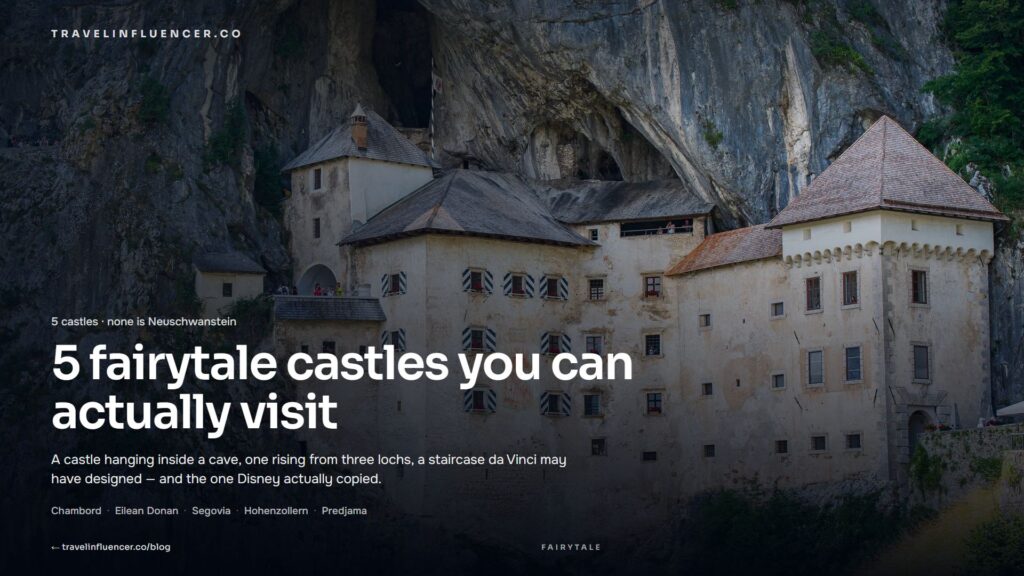
1. Predjama Castle (Slovenia)
For more than 800 years, a castle has hung inside the mouth of a 123-metre cliff in Slovenia’s karst — the largest cave castle in the world, certified by Guinness World Records. First mentioned in 1274, it entered legend with the knight Erasmus of Predjama: besieged for about a year by the Habsburg army, he stayed supplied — and, the story goes, taunted the besiegers with fresh cherries — thanks to a secret tunnel running through the mountain.
Today you walk the castle rooms built right into the cave, follow the guided tour through the chambers behind them, and pair it with Postojna Cave nine kilometres away for the full underworld day. Every July, the castle hosts a knight tournament beneath the cliff.
Best for: the most implausible castle placement in Europe. · largest cave castle on Earth · Erasmus’ secret tunnel · Postojna Cave next door
How to plan a fairytale-castles trip
These five span France, Scotland, Spain, Germany and Slovenia — pick one per trip and pair it with its region. Chambord anchors the Loire’s château country; Eilean Donan sits on the classic route to Skye and the North Coast 500; Segovia is an easy day trip from Madrid; Hohenzollern pairs with Tübingen and Lake Constance; Predjama with Postojna, Ljubljana and Lake Bled.
All five are open year-round, with nuances: Hohenzollern’s clouds come with autumn and winter mornings; Segovia sizzles in July and August — go early and finish with a cathedral-shadow lunch; Predjama’s cave stays cool whatever the season; Chambord’s timed entries sell out in summer, so book ahead. And wherever you climb, buy the combined tickets: most of these castles pair with a stronger neighbour.
Want to turn one of these trips into an interactive guide you can share, with your own map, your stops and your links next to every flight and hotel? Build it in your own travel app with Travelinfluencer.co. Build your app
Mini FAQ
When’s the best time to go?
All five are open year-round. For Hohenzollern’s clouds, aim for an autumn or winter morning. For everything else, spring and early autumn beat the summer queues.
How fit do I need to be?
Easy. All five are walkable; the towers mean stairs (Segovia’s Tower of John II is the steepest) and Predjama’s cave tour involves a little stooping.
Is it expensive?
Roughly museum pricing — expect €10–20 per castle. The Predjama + Postojna combination ticket is the best value of the five.
Is it good for kids?
Very: knights, spiral staircases, crown jewels and a cave behind the castle. Segovia and Predjama are the biggest hits.
Can I take photos?
Yes everywhere outdoors and in most rooms; skip the flash and tripods indoors, as with any museum.
In short
A staircase da Vinci may have designed, a castle rebuilt from ruin on three lochs, the stone ship that proclaimed a queen, a fortress floating above the clouds, and 800 years of castle hanging inside a cave. Neuschwanstein can keep its queues — these five fairytale castles are open, and waiting.
Book your timeslot, charge your camera, and you’ll come home with the photos nobody else was queuing for.
Build your own guide at travelinfluencer.co and turn the trip into something that’s yours.