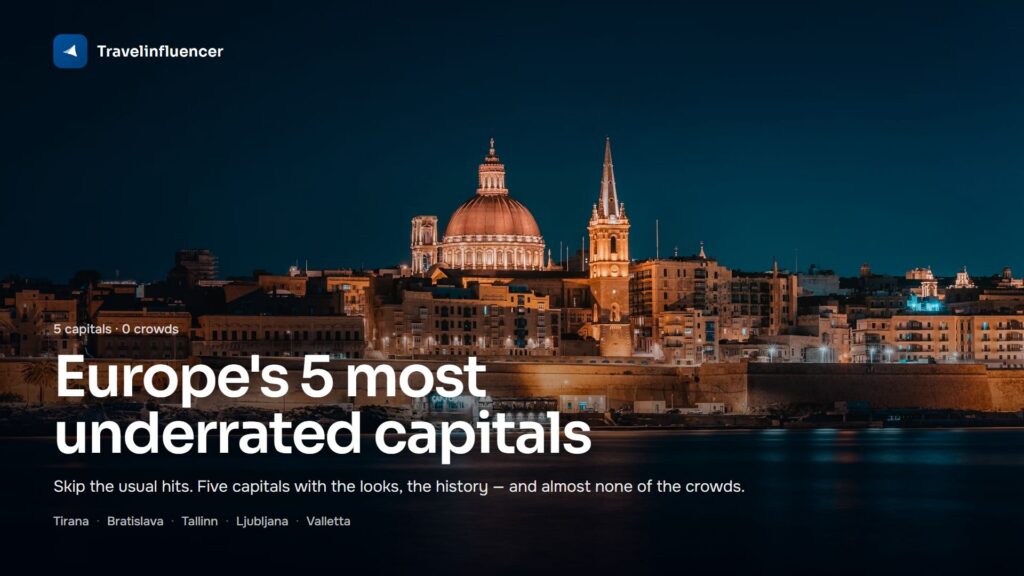
Europe’s 5 most underrated capitals (and why you should skip the usual hits)

Europe’s greatest hits need no introduction — and, in summer, no introduction to the crowds either. Rome, Paris and Prague are magnificent, and they are heaving. The trick is to look at the map a little differently, at the capitals almost everyone races past.
These five have the looks and the history of the famous names — pastel streets, knight-built fortresses, medieval walls and dragon-guarded bridges — with a fraction of the visitors. Each is small enough to walk end to end in a day, yet layered enough to fill three.
Here they are, ranked from a great city break up to an unforgettable one, ending on the most complete of them all. For each: what to do, and why it earns the detour.
A quick note before you go: these are compact, walkable capitals, so a long weekend is enough for one — but book ahead in peak season, when cheap flights fill up and the best old-town stays sell out fast.
5. Tirana (Albania)
Tirana is Europe’s most unexpected reset. Closed off and grey for decades, the Albanian capital has repainted itself in cheerful pastels — whole façades of yellow, pink and turquoise — while the concrete bunkers of its communist years have been turned into art, including Bunk’Art, a nuclear shelter reborn as a history museum.
Start on Skanderbeg Square as the evening lights come on and the city comes out to stroll, dive into the Bunk’Art bunkers for a crash course in the country’s past, then ride the cable car up Mount Dajti for a sunset view over the whole basin. The café culture runs deep and the prices still surprise.
Best for: pastel streets, bunker art and the most surprising city break in Europe. · Skanderbeg Square · Bunk’Art · Mt Dajti
4. Bratislava (Slovakia)
Almost everyone races past Bratislava on the way to Vienna or Prague. That is their loss. A castle watches over the Danube, a storybook old town tumbles down below it, and bronze statues peek out from the corners — all walkable in an afternoon.
Climb to Bratislava Castle for the view up and down the river, wander the cobbled lanes of the Old Town to the Gothic St Martin’s Cathedral, and end the day on the UFO Bridge, where a flying-saucer observation deck looks back over the whole city. The cafés are excellent and remarkably good value.
Best for: a castle over the Danube, a fairy-tale old town and a city break almost no one expects. · Bratislava Castle · Old Town · UFO Bridge
3. Tallinn (Estonia)
Tallinn is a medieval city straight out of a storybook — and its Old Town is one of the best-preserved Hanseatic centres on earth, listed by UNESCO since 1997. Spires, cobblestones and gabled merchant houses sit inside the original city walls, all small enough to explore on foot.
Lose yourself in Vanalinn, the winding old quarter, climb to Toompea Hill for the long view over the red roofs to the Baltic, and walk a stretch of the surviving city walls and towers. In winter the squares turn into a lamplit Christmas market; in summer the days barely end.
Best for: medieval walls, Hanseatic charm and a fairy-tale you can walk across in a day. · Vanalinn · Toompea · city walls
2. Ljubljana (Slovenia)
Ljubljana is small, green and impossibly charming. Its car-free old town curls around the jade waters of the Ljubljanica river, crossed by bridges guarded by dragons, with a castle floating on the hill above. It feels less like a capital and more like a very well-kept secret.
Stroll across the Triple Bridge designed by Jože Plečnik, drift down the Ljubljanica on a small boat at dusk, and climb up to Ljubljana Castle for the view. After dark, the alternative arts quarter of Metelkova — built from old army barracks — keeps the night going.
Best for: a car-free old town, dragon bridges and the greenest small capital in Europe. · Triple Bridge · Ljubljanica · Metelkova
1. Valletta (Malta)
Valletta is the most complete capital on this list, and arguably the most cinematic. A tiny baroque fortress-city built by the Knights of St John on a peninsula between two grand harbours, it packs palaces, cathedrals and sea walls into a grid of golden stone you can cross on foot in twenty minutes.
Step inside St John’s Co-Cathedral for Caravaggio’s masterpiece, watch the cannon fire at the Upper Barrakka Gardens over the Grand Harbour, and wander down Strait Street, once the sailors’ nightlife strip, now restored into bars and boutiques. The whole city is a UNESCO World Heritage Site (City of the Order, inscribed in 1980).
Best for: knight-built fortresses, grand harbours and the most photogenic capital of all. · St John’s Co-Cathedral · Upper Barrakka · Strait Street
How to plan an underrated-capitals trip
These five sit across the map — the Balkans, the Baltics, the Med — so don’t try to string them all into one trip. Pair them instead: a Balkan loop taking in Tirana; a Baltic hop around Tallinn; or a short flight to Valletta, which you can combine with the rest of Malta and sister-island Gozo.
All five capitals are compact and walkable, so you will rarely need a car — pack light and base yourself in the old town. Low-cost carriers serve every one of them, but seats vanish in July and August, so lock in flights and rooms early, and aim for May–June or September for warm weather without the peak-season crush.
Want to turn any of these into an interactive guide you can share, with your own map, your stops and your links next to every flight and hotel? Build it in your own travel app with Travelinfluencer.co. Build your app
Mini FAQ
When’s the best time to go?
May–June and September — warm, walkable and far quieter than July–August, when flights and hotels sell out.
How many days do I need?
Two to three nights is plenty for one capital; add more if you’re pairing cities.
Are they walkable?
Yes — all five have compact, largely flat old centres; you’ll rarely need transit.
Is it expensive?
Less than Rome or Paris. Tirana and Bratislava are notably cheap; Tallinn, Ljubljana and Valletta sit in the middle.
How do I get there?
Low-cost airlines fly to all five; Valletta and Tallinn also have direct ferries from Italy and Finland respectively.
Is it safe?
Yes — these are safe, low-hassle capitals; normal city sense applies.
In short
Europe’s famous capitals are magnificent, and full. These five — Tirana, Bratislava, Tallinn, Ljubljana and Valletta — are where you find the same looks and history with almost none of the crowds, ending on Valletta, the most complete of them all.
Skip the usual hits, walk slowly, and you’ll come home with the city break everyone else was queuing for.
Start free at travelinfluencer.co and turn the trip into a guide that’s yours.