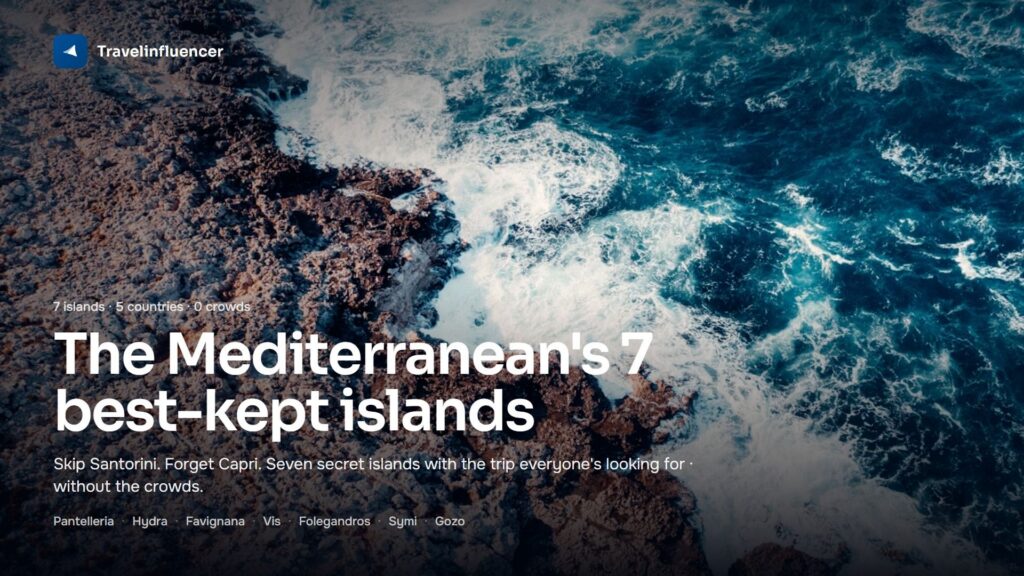
The 7 Mediterranean islands no one talks about (and how to visit them)

The Mediterranean in summer is the most contested coastline on earth. Santorini, Capri, the Amalfi Coast — all magnificent, and all heaving. The trick is to go one island over, to the ones everyone forgets.
These seven are the secret sisters of the famous names: volcanic, car-free, military-sealed, Cycladic, neoclassical, prehistoric. Each one delivers the trip everyone is looking for — blue water, good food, a view that stops the scroll — without the crowds that make the famous islands exhausting in July.
Here they are, ranked from a great trip up to an unforgettable one, ending on the most complete island of all. For each: what to do, and why it’s worth the detour.
A quick note before we start: ferries and weather can shift, so check sailing times before you commit. Book early — a Mediterranean summer means full boats and full hotels everywhere.
7. Pantelleria (Italy)
Pantelleria is Italy’s most cinematic island and almost no one goes. Closer to Tunisia than Sicily, it’s a black volcanic outcrop crowned by dammusi, the ancient domed stone houses that stayed naturally cool centuries before air conditioning existed.
Swim in the Specchio di Venere, a saltwater lake that turns turquoise and is said to be the goddess’s mirror, walk under the Arco dell’Elefante sea arch, and soak in natural hot springs right by the sea. The capers and passito wine are unlike anywhere else in Italy.
Best for: volcano drama, off-grid calm and Italy without the crowds.
6. Hydra (Greece)
One walk through Hydra’s harbor and you understand the law: no cars, no motorcycles, no neon. Stone captains’ mansions from the 18th century line the water, and the only traffic is donkeys.
Swim at Spilia, a cliff-edge spot where locals dive off the rocks at golden hour, hike the coastal paths to lonely monasteries, and let the absence of engines slow you down. It’s a time capsule you reach by hydrofoil from Athens in under two hours.
Best for: a car-free reset, elegant Greek nights and an easy escape from Athens.
5. Favignana (Italy)
Favignana is the butterfly of the Aegadian Islands, a flat, bikeable stretch off Sicily’s west coast where the water is so clear it looks retouched. Once the site of grand tuna fisheries, today it’s about slow days and hidden coves.
The showstopper is Cala Rossa, a cove of impossibly turquoise water between pale cliffs; swim into the Bue Marino sea cave, and lunch inside one of the old tuff quarries turned into lush gardens. Rent a bike in town and let the sea decide the route.
Best for: cycling days, Sicilian food and the clearest water off Italy.
4. Vis (Croatia)
Vis was a closed Yugoslav naval base until 1989, off-limits to foreigners for decades — which is exactly why it stayed so wild. It’s the furthest inhabited island from the Croatian coast, so it asks for a little more effort and rewards it generously.
Boat to Stiniva, a beach walled in by cliffs and once voted Europe’s best, float inside the Blue Cave on neighbouring Biševo when the light glows electric blue, and lose yourself in Komiža, a fishing village that feels frozen in time.
Best for: secret beaches, military history and Croatia away from the hordes.
3. Folegandros (Greece)
Folegandros is the Cyclades without the circus: the whitewashed lanes, the blue domes, the sheer cliffs above an infinite Aegean — all of it, with a fraction of Santorini’s crowds. Its Chora is arguably the most beautiful village in the islands.
Wander the traffic-free Chora built on the edge of a 200-metre cliff, climb to the Panagia church for the sunset, and hike down to Ágios Geórgios, a beach you can only reach on foot. There’s no airport, which is the whole point.
Best for: Cycladic beauty, cliff-edge villages and genuine quiet.
2. Symi (Greece)
Round the headland into Symi’s harbor and the view stops you cold: a neoclassical amphitheater of pastel mansions rising straight out of the sea, restored and faded in equal measure. It’s regularly called the prettiest harbor in Greece.
Climb the stairs through the tiers of houses, take a boat to the baroque Panormitis monastery, and swim at Nanou Bay where pine forest comes down to the pebbles. Symi is a day-trip from Rhodes, but it deserves a night.
Best for: a postcard harbor, neoclassical color and boat days.
1. Gozo (Malta)
Gozo is Malta’s calm, green sister — slower, quieter and more complete than you expect. It holds the Ġgantija temples, built over 5,000 years ago and a thousand years older than the Pyramids, along with salt pans, sea arches and some of the bluest water in Europe.
Kayak into Wied il-Għasri, a narrow inlet squeezed between golden cliffs, stand inside the Ġgantija temples, and swim through the rock tunnel at Dwejra’s Inland Sea. Gozo is the island that has everything the Mediterranean promises, in one small place.
Best for: ancient history, wild coast and the most complete island on the list.
How to plan your Mediterranean island summer
The Mediterranean is bigger than it looks: five countries are on this list alone (Italy, Greece, Croatia, Malta), so don’t try to island-hop all of them in one trip. Pick one country or one archipelago — the Aegadians off Sicily, the Cyclades, the Dalmatian coast — and go deep rather than wide.
Ferries are the backbone: book early in high season, build in a buffer day for wind (the meltemi in Greece, the bura in Croatia can cancel sailings), and always have a plan B island. You don’t need a car on most of these — Hydra bans them, Folegandros and Favignana are better by bike — so travel light.
Want to turn this into an interactive guide you can share, with your own map, your stops and your links next to every ferry and hotelBuild it in your own travel app with Travelinfluencer.co. Build your app
Mini FAQ
When’s the best time to go?
June and September are ideal — warm, swimable and far quieter than July–August, when ferries and hotels sell out.
Do I need a car?
Rarely. Hydra bans cars; Folegandros, Favignana and Gozo are easy by foot, bike or scooter. Symi and Vis are best explored by boat.
Is it expensive?
Less than the famous islands. Pantelleria, Folegandros and Favignana are notably cheaper than Capri or Santorini; Gozo offers Malta-value prices.
Are the ferries reliable?
Mostly, but wind cancels sailings — always keep a buffer day and book through the official operators.
Is it safe?
Yes — these are quiet, low-crime islands; standard beach and sun sense applies.
In short
The Mediterranean’s famous islands are magnificent and full. These seven — Pantelleria, Hydra, Favignana, Vis, Folegandros, Symi and Gozo — are where you find the same blue water and better stories, ending on Gozo, the most complete of them all.
Go one island over, travel slowly, and you’ll come home with the summer everyone else was queueing for.
Start free at travelinfluencer.co and turn the trip into a guide that’s yours.