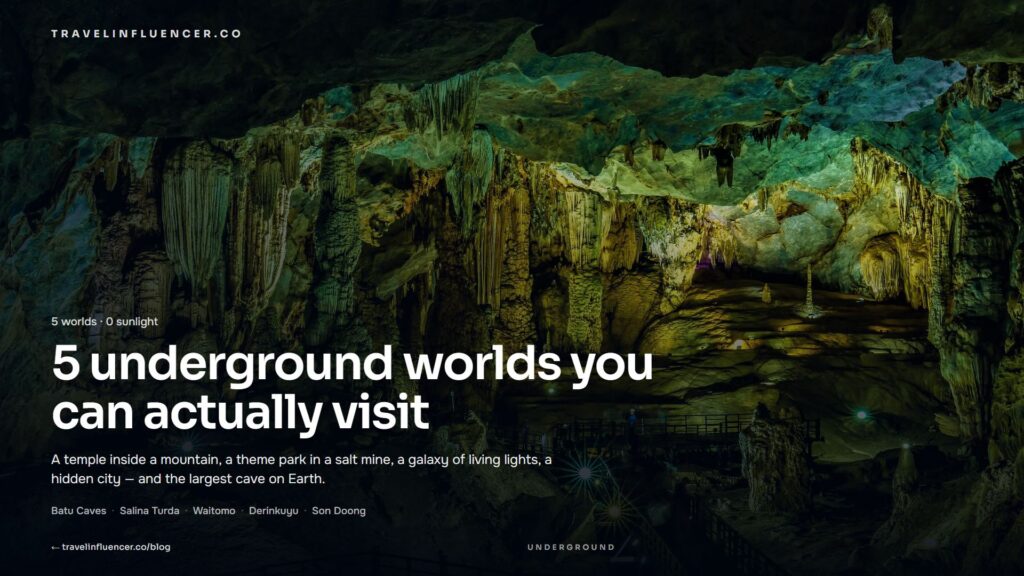
5 underground worlds you can actually visit

Most trips stay on the surface. But some of the most extraordinary places on Earth are underneath it — and almost none of them require you to be a caver.
These five are real, open-to-visitors underground worlds: a Hindu temple inside a 400-million-year-old limestone hill, a theme park 112 metres down a salt mine, a river of living blue light, an entire hidden city that sheltered 20,000 people, and a cave so vast it has its own jungle, river and clouds.
Here they are, ranked from a great detour to the most cinematic descent on the planet. For each: what to do, and how to make it happen.
One note before you descend: underground stays 10–20 °C all year, so pack a light layer even in summer — and book ahead: several of these cap visitor numbers, for good reason.
5. Batu Caves (Malaysia)
Just north of Kuala Lumpur, a limestone hill older than the dinosaurs opens into chambers the size of cathedrals. A staircase of 272 steps painted in rainbow colours climbs to the Temple Cave, watched over by a 42.7-metre golden statue of Lord Murugan — one of the tallest statues in Asia. Entry to the main temple is free.
Climb alongside the resident macaques (hold onto your sunglasses), look up at the vast vault lit by holes of daylight, then explore the darker shrine chambers and the framed openings to the sky. Go early morning: the steps are cooler, emptier and at their most photogenic.
Best for: a temple inside a mountain, free entry and the most colourful staircase in Asia. · Temple Cave · 272 rainbow steps · Lord Murugan statue
4. Salina Turda (Romania)
In Transylvania, a salt mine first documented in 1271 descends 112 metres underground. Its Rudolf hall — a cavern of pale salt lit like a science-fiction film set — is now an underground amusement park: a Ferris wheel, mini-golf, bowling and rowing boats on a small salt lake, all at a constant 12 °C.
Ride the panoramic lifts or the spiral stairs down through the mine’s centuries, row across the underground lake in the Terezia shaft, and stand in the Echoes Room, where the acoustics turn a whisper into a choir. It is easily done as a day trip from Cluj-Napoca.
Best for: science-fiction architecture, a Ferris wheel underground and a boat on a salt lake. · Rudolf Mine · underground lake · Echoes Room
3. Waitomo Glowworm Caves (New Zealand)
In the Waikato hills of the North Island, a river disappears into a limestone cave system whose vaults are carpeted with thousands of glowworms — Arachnocampa luminosa, larvae that glow blue-green to lure their prey. The result is a false sky of living constellations.
The visit ends with the part nobody forgets: a boat pushed in silence through the dark grotto, drifting beneath the glow reflected in still black water. For a wilder version, the same region offers black-water rafting and tubing through Ruakuri Cave’s glowworm galleries.
Best for: a silent boat ride under a sky of living lights. · glowworm grotto · boat ride · black-water rafting
2. Derinkuyu (Türkiye)
In 1963, a Cappadocian resident renovating his home broke through a wall — and found a city. Derinkuyu is the largest of the region’s underground cities: as many as 18 levels reaching roughly 85 metres down, with stables, cellars, churches, wine presses, wells, oil lamps niches and ventilation shafts — enough to shelter some 20,000 people, with their livestock, for months. Hidable behind rolling stone doors that still swing today.
You walk the excavated tunnels (about a tenth of the city is open), see the cross-shaped church, the missionary school and the 55-metre ventilation shaft, bent-backed through tunnels engineered three thousand years ago and enlarged for centuries.
Best for: walking through a genuine hidden city, three millennia old. · 18 levels · rolling stone doors · 55-m ventilation shaft
1. Son Doong (Vietnam)
The largest cave on Earth. Inside Phong Nha-Ke Bang National Park in central Vietnam, Son Doong runs about 5 kilometres, with chambers up to 200 metres high and 150 metres wide — tall enough to stack a 40-storey skyscraper, big enough for a city block. It is so vast that it holds its own jungle, its own river and its own clouds.
It is visited one way only: a four-day, three-night expedition with the licensed operator, trekking and caving through the jungle, camping inside the mountain and wading the underground river. Around a thousand people per year are allowed in — fewer than have summited Everest.
Best for: the most cinematic descent on the planet. · world’s largest cave · jungle inside · 4-day expedition
How to plan an underground-worlds trip
These five are scattered across the map — Malaysia, Romania, New Zealand, Türkiye, Vietnam — so pick one per trip and pair it with its region. Batu Caves is a half-day from Kuala Lumpur; Salina Turda pairs with Cluj-Napoca and Transylvania; Waitomo sits between Auckland and Rotorua; Derinkuyu with Cappadocia’s cave hotels and balloons; Son Doong with Phong Nha-Ke Bang’s lesser caves and the DMZ coast road.
Seasons are forgiving: the first four run all year — Batu in the early morning, Derinkuyu a blessed 13 °C in the Cappadocian summer. Son Doong is the exception: expeditions run in the dry season only, roughly February to August, and often book out a year ahead. Wherever you descend, go with a guide where required and keep to the paths: these are fragile worlds.
Want to turn one of these descents into an interactive guide you can share, with your own map, your stops and your links next to every flight and hotel? Build it in your own travel app with Travelinfluencer.co. Build your app
Mini FAQ
When’s the best time to go?
All year for Batu, Salina Turda, Waitomo and Derinkuyu; Son Doong only in the dry season, about February–August.
How fit do I need to be?
Salina Turda and Waitomo are easy. Batu is 272 steps. Derinkuyu means stooping through low tunnels. Son Doong is a demanding 4-day trek with river crossings.
Is it expensive?
Batu’s main temple is free; Salina Turda and Derinkuyu are museum-priced; Waitomo tours start around NZ$60; Son Doong’s expedition is the investment of a lifetime.
Is it good for kids?
The first four, yes. Son Doong expeditions are 18+.
Can I take photos?
Yes everywhere except the Waitomo grotto itself, where photography is banned to protect the glowworms — you’ll just have to remember that one.
In short
A temple under a hill, a Ferris wheel in a salt mine, a sky of living lights, a hidden city, the largest cave on Earth. The surface is optional — these five underground worlds are open, and waiting.
Pack a layer, book ahead, and you’ll come home with the photos nobody else was queuing for.
Build your own guide at travelinfluencer.co and turn the trip into something that’s yours.